Storefront Door Closer Repair in Buffalo
Storefront door closers do a quiet, heavy job on Buffalo commercial doors. A hydraulic door closer, which is the metal box and arm that control how a door swings and shuts, takes the full load on every entry and exit. In Buffalo and Western New York, closers face higher stress than most markets because winter cold thickens hydraulic fluid, wind off Lake Erie pushes doors hard, and daily traffic counts run high on streets like Elmwood Avenue, Hertel Avenue, and Main Street. When a closer leaks oil, slams, or will not pull the door fully closed, the storefront loses security, comfort, and code compliance. This page explains how closer repair actually works on Buffalo storefronts and what commercial decision-makers should expect from a professional service call.
A-24 Hour Door National Inc. Focuses on commercial storefront systems across Buffalo, Cheektowaga, West Seneca, Hamburg, Orchard Park, Amherst, Tonawanda, and the broader Western New York corridor. Most service calls begin with a closer diagnosis, because the closer is the highest-failure-rate component on an aluminum storefront door. The team sees the same patterns every winter and again during spring thaw. Understanding those patterns helps a property manager plan repairs that last through the season.
Why Buffalo storefronts need closer repair different from other markets
Buffalo sits at the east end of Lake Erie in ASHRAE Climate Zone 5A. Lake-effect snow delivers 95 to 100+ inches of annual snowfall. Winter nights drop below 20°F, which is the threshold where hydraulic closer fluid begins to thicken and lose damping consistency. Thickened fluid stresses internal seals. Seals then leak, and the closer loses control. That is why Buffalo storefront door closers fail at a higher rate in late fall through February than in many other cities.
Wind is the other local force. The average wind speed at Buffalo Niagara International Airport sits near 12 mph, with frequent gusts during storm events. A gust slams into a door and hammers the closer arm and spindle. Over time, that loading backs off adjustment screws and accelerates wear on the pinion bushing inside the closer body. Doors along the Waterfront, Canalside, and the Cobblestone District see this daily. So do exposed entries on Transit Road, Walden Avenue, and Niagara Falls Boulevard.
Salt and moisture complete the picture. Road salt from sidewalks and parking lots gets tracked into pivot pockets and across thresholds. This corrosion does not only affect pivots. Corroded thresholds and misaligned frames add drag that the closer must fight on every cycle. That extra drag shortens closer life. These forces fall hardest on high-cycle doors. Busy Elmwood Village and Hertel Avenue storefronts can see 500 to 3,000+ door cycles per day. That count outpaces office parks and raises the service frequency for closers and pivots alike.
How a storefront door closer actually works on a Buffalo aluminum door
A storefront closer is a small hydraulic machine. Inside the metal body is hydraulic fluid and a spring. When someone opens the door, the arm turns a shaft that compresses the spring and moves fluid through channels. When the user lets go, the spring pushes back and the fluid meters through valves so the door returns in a controlled way. The goal is a smooth open, steady sweep, firm latch, and no slamming.
On aluminum storefronts, closers come in three common types. A surface-mounted closer bolts to the door or frame and uses a visible arm. It is popular because it is easy to service. A concealed overhead closer, such as the Dorma RTS88, hides in the header and uses an arm inside the top rail. A floor-mounted concealed closer, often a Rixson unit, sits below the threshold and turns a spindle that runs up into the bottom of the door. Each type handles cold, salt, and door size differently, and each requires its own parts and skill set.
Three key adjustments control how a closer behaves. Sweep speed is the main swing from open to near closed. Latch speed is the last few inches where the door needs a little extra push to engage the latch. Backcheck is the resistance near full open that prevents the door from smashing into a wall when someone throws it open or when wind catches it. Some closers also include delayed action, which holds the door open longer for assisted access, and some arms include a hold-open feature that keeps the door at a set angle until pushed. In Buffalo, backcheck is critical because of wind. Latch speed is critical in winter because weatherstripping stiffens and thresholds ice up.
Failure signs line up with specific parts. An oil slick on the door or floor under the closer signals seal failure. A door that slams signals low fluid or a failed valve. A door that will not latch may have weak spring force, wrong latch speed setting, or extra drag from misaligned pivots or a corroded threshold. A door that will not stay open may have a worn hold-open arm or a hold-open feature removed for fire code reasons. When a door drifts open on a windy day, backcheck and sweep tuning are likely off, or the closer sizing is wrong for the door and environment.
Real storefront conditions that push closers past their limits
Buffalo building archetypes show repeat issues. Historic main street properties along Allen Street, Grant Street, and Main Street often have aluminum storefronts retrofitted into older brick openings. These openings settle. Frames rack. An out-of-square opening creates rub at the head or threshold. The closer then has to push a rubbing door through the last inch. Many slamming complaints trace back to frame and pivot alignment, not the closer itself.
Mid-century strip plazas across Cheektowaga, Amherst, West Seneca, Hamburg, and Orchard Park often run older Kawneer, Vistawall, or US Aluminum systems. On these sites, an original LCN or Norton closer may have been replaced a few times, sometimes with lower-grade models that cannot handle the cycle count. A Grade 1 closer, which is a heavy-duty rating for commercial use, is the right choice for Buffalo retail because it survives wind gusts and thousands of cycles. Substituting a light-duty unit shortens service life and raises total cost.
Big-box and mixed-use buildings on McKinley Parkway, Walden Avenue, Transit Road, and Niagara Falls Boulevard add another load. Large vestibules with double sets of doors create pressure differences. If the HVAC system is not balanced, the inside set can fight a steady stack effect. That continuous push turns into extra closer wear and can mask as a latch problem. A field tech measures opening force and watches the latch throw to decide if this is a closer issue, an air balance issue, or both.
Brands and hardware Buffalo facilities see every week
Across Buffalo and Western New York, the common aluminum storefront systems include Kawneer Trifab 350, 400, 450, and 500 series, Kawneer 190 and 190D narrow stile doors, Tubelite T14000 and T24000, YKK AP YES 45 XT and YES 60 XT, and legacy Vistawall and US Aluminum frames. These frames accept standard narrow stile doors, which are the 2-1/8 inch face width door leaves most people see in retail. Medium stile at 3-1/2 inches and wide stile at 5 inches show up on heavier entries, restaurants, and banks. The stile width matters for picking the correct closer arm and mounting plate, and for making sure the latch throw lines up with the strike.
Closer brands the service trucks carry are LCN, Norton, Dorma, Sargent, and Rixson. The LCN 4040 series is the Buffalo workhorse for surface closers. It handles heavy doors, heavy wind, and busy sites. The LCN 4110 and 1460 series also show up, depending on frame conditions and mounting choices. Norton 1600, 8000, and 9500 series are common in legacy installations and replacements. Dorma RTS88 is the standard name seen inside many concealed overhead headers. Sargent 281 and 351 series fill in with strong performance on surface mounts, and Rixson floor closers support older and premium entrances where a clean look or a balanced swing matters.
On the pivot and hinge side, Kawneer TH1118 offset pivot sets and the 050331 intermediate pivot are standard for taller doors and high-cycle entries. These pivot sets carry the door on a pin at the bottom and guide it at the top. An intermediate pivot, which is an extra hinge placed midway up tall doors, stabilizes the leaf against twist. A worn bottom pivot bearing adds drag and sags the door. The closer must then fight the sag every time it tries to pull the latch. That is why many closer complaints end up with a pivot replacement and a fresh closer tune.
What a closer-focused diagnostic looks like on a Buffalo service call
A good closer diagnosis respects the ADA and life safety rules. The ADA door force standard targets 5 pounds of opening force for interior doors. Exterior doors are allowed to be higher to resist weather, but the goal is still low force. NFPA 101 and IBC Chapter 10 require egress doors to unlatch with a single motion and to close and latch reliably. A field tech checks opening force with a gauge, watches sweep and latch action, and confirms that panic bars or Adams Rite locks engage without binding. If an automatic operator is involved, the AAADM requirements and ANSI A156.19 apply, which set timing and safety sensor rules for automatic swing doors.
On a manual storefront door, the tech first looks for oil. Oil weeping out of a closer body means a failed seal and a short timeline to replacement. If no oil is present, the tech checks mounting screws, arm condition, and the adjusters. The sweep, latch, and backcheck valves should be under control. An over-adjusted backcheck can stall a door. An under-adjusted latch leaves the door to bounce open on a windy day. In Buffalo winters, a closer may need a firmer latch setting to punch through stiff weatherstripping.
Next, the tech inspects pivots, threshold, and the meeting stile astragal on pairs. The astragal is the vertical strip that seals where two doors meet. A bent astragal makes the latch look weak when the real issue is interference. The aluminum threshold often tells a story in salt country. Pitting and corrosion raise the sill and scrape the door sweep. That drag adds to the closer load and changes how the last inch behaves. Correcting these drags can save an otherwise healthy closer from early replacement.
Winter behavior every Buffalo property manager should plan around
Below 20°F, most closer hydraulic fluids thicken enough that valves feel sluggish. In the field, that shows up as slow sweep in the morning and a faster sweep in the afternoon once the vestibule warms. The inconsistency breaks seals over repeated freeze-thaw cycles. That is why fall pre-winter service in Buffalo delivers strong returns. Catching small weeps, re-sealing mounting holes, checking arm geometry, and confirming backcheck before the first hard freeze prevents emergencies when the holiday rush hits.
Cycle count matters even more in winter. A coffee shop near Canalside during a Sabres home game night sees a door cycle every few seconds. Without a Grade 1 closer and a healthy pivot set, that cycle count will multiply the effect of cold-thickened fluid and wind. A surface closer such as an LCN 4040 set with firm backcheck and a correct arm configuration is a proven setup for those nights.
Surface, concealed overhead, and floor closers: what changes in repair
Surface-mounted closers are the fastest to service. The body is visible. The arm and shoe are accessible. If a body leaks, a swap to a stocked replacement can happen the same visit. Concealed overhead closers hide inside the header. When they leak, oil stains sometimes show along the top rail, or the door may sag slightly as internal parts bind. Repairs require dropping the door and opening the header. Floor closers live below grade and interact with snow and meltwater. They last a long time when sealed and maintained, but once they leak, replacement is the usual path. In Buffalo, a concealed unit that fails in winter needs careful board-up planning if parts are not on the truck, which is why carrying common Dorma RTS88 bodies and Rixson kits on the van matters.
Arm types change the field approach too. A regular arm projects off the door and frame and gives strong mechanical advantage. A parallel arm folds up against the top of the door and frame for a cleaner look and better vandal resistance. Parallel arms often need a slightly stronger closer to get the same control. Hold-open arms, which keep the door open at a set angle, are common in retail but can conflict with fire egress rules on some occupancies. A Buffalo tech will confirm use and code with the property manager before replacing a like-for-like hold-open arm.
Aluminum storefront compatibility and common mix-ups
Most aluminum storefront frames will accept a range of closer brands with the right mounting plate and arm. The pitfall is door handing and shoe position. A left-hand door viewed from outside storefront door repair Buffalo, NY uses a mirror-image arm and sometimes a different shoe. Another mix-up happens on narrow stile doors when a standard arm shoe hits glass. Choosing a slim shoe or sliding the shoe along the reveal fixes this without drilling into the glass sightline.
For Kawneer, Tubelite, YKK AP, Browse around this site and Vistawall frames, the service team carries plates and brackets that align with factory hole patterns. That avoids field-drilling into anodized or painted surfaces in public-facing entries. On pairs with a meeting stile astragal, the right closer sizing, arm geometry, and latch speed are vital. A weak latch setting lets wind push the inactive leaf open. A strong backcheck and tuned latch end that bounce without forcing the user to fight the door.
Response coverage and parts on the truck across Buffalo and WNY
A-24 Hour Door National Inc. Dispatches from 344 Sycamore Street in the 14204 corridor. Crews cover Downtown 14202, the Medical Corridor 14203, West Side 14213, University District 14215, South Buffalo 14220, Cheektowaga 14225, Amherst and Getzville 14228, Williamsville 14221, Hamburg 14075, Orchard Park 14127, and Tonawanda 14150. After-hours emergency response within Buffalo city typically arrives within the hour. Outer suburbs run within two hours in most weather conditions. During lake-effect events, the office communicates realistic windows and stages materials for single-visit repairs as roads allow.
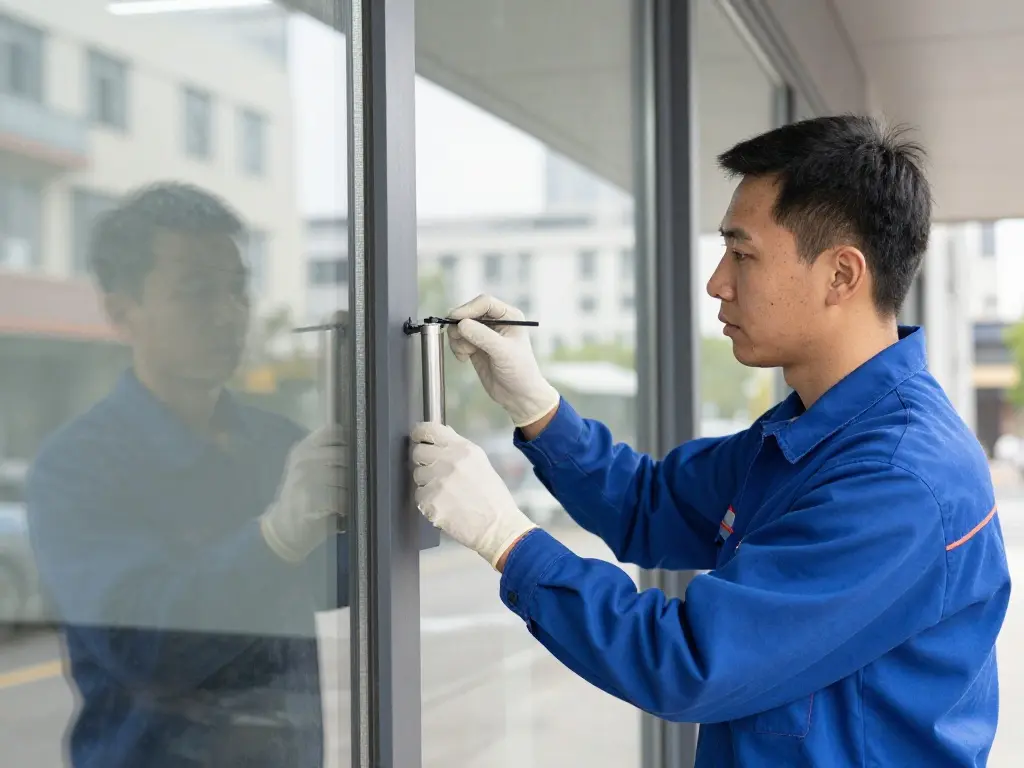
Service trucks carry common surface and concealed closer bodies and arms, including LCN 4040, 4110, and 1460 series, Norton 1600, 8000, and 9500 series, Dorma RTS88 concealed overhead units, and Sargent 281 and 351 series. Trucks also stock Kawneer TH1118 pivot sets, 050331 intermediate pivots, Adams Rite MS1850 deadbolts, narrow stile deadlatches, EPDM bulb weatherstripping, door sweeps, aluminum thresholds, and board-up plywood. This inventory supports a single-trip repair model for most storefront door closer failures, which avoids the diagnose-now, return-later delays that general glaziers often face.
Typical storefront door closer repair scope and cost in Buffalo
Actual costs depend on door type, mounting style, brand, and whether hidden damage exists. A surface-mounted closer swap on a standard aluminum storefront door is the most straightforward job. Concealed overhead and floor units add labor for access. If salt corrosion or frame racking has added drag, the service may include a pivot bearing replacement, threshold work, or a light frame adjustment to restore proper clearances.
Two facts help frame decisions. First, preventive replacement of worn pivot bearings before they seize typically runs in the $150 to $450 per set range during normal hours. If a pivot fails during business hours and the door jams or the glass breaks, the after-hours premium and potential glass replacement can raise emergency costs by 50 to 100 percent. Second, surface closers can often be replaced same-day from truck stock. Concealed overhead and floor closer replacements may require brand-specific bodies but are also frequently completed in one visit due to stocked RTS88 and Rixson kits.
- Diagnostic and tune of a surface closer with sweep, latch, and backcheck adjustments on a Buffalo storefront: often part of a standard service call. Surface closer body replacement with a Grade 1 unit such as an LCN 4040, including arm and shoe: variable by brand and finish, labor typically under two hours when no other issues exist. Concealed overhead closer replacement, Dorma RTS88 type, including door removal and header access: added labor for access and alignment. Floor closer replacement on legacy entries, including threshold work and spindle alignment: highest labor, often scheduled to minimize business disruption. Companion work if needed, such as Kawneer TH1118 bottom pivot bearing replacement, Adams Rite strike alignment, and weatherstrip renewal to reduce latch resistance.
Material prices have risen in recent years, especially for specialty finishes and heavy-duty arms. The service team always scopes the job on site and confirms a repair-first path when safe and practical. A repair that restores safe closing and code compliance is the priority in active business hours. Upgrades and cosmetic work follow when the entry is stable and secure.
Standards that apply to Buffalo storefront doors with closers
Even manual storefront doors intersect with accessibility and life safety rules. The ADA sets a 5 pound opening force target for interior manual doors. Exterior storefronts are weather doors and may exceed 5 pounds, but the closer should still be tuned to the lowest safe force that latches the door in wind. NFPA 101 and IBC Chapter 10 require free egress. This means no special knowledge, one motion to exit, and a door that closes and latches. If a storefront has an automatic swing operator, AAADM certification and ANSI A156.19 govern operation, timing, and sensing. For sliding automatics, ANSI A156.10 applies. A tech should always check that closer settings support these rules and do not create a barrier to access.
Glazing also matters. Storefront glass is safety glazing. Tempered glass follows ASTM C1048, laminated safety glass follows ASTM C1172, and insulated glass units follow ASTM E2190. While a closer repair may not touch glass, a slamming or bouncing door can break tempered glass at the edge. That is why an oil-leaking closer is more than a nuisance. It is a risk to glass and to people in the entryway.
Maintenance intervals and the Buffalo calendar
Fall pre-winter service in September or October is the single highest-ROI visit on Buffalo storefront doors. The goal is to stabilize closers before fluid thickening and wind season arrive. The visit usually includes closer valve checks, arm and shoe tightening, pivot lubrication, weatherstrip inspection, and a latch test in wind. Semi-annual service works well for high-cycle retail and restaurant doors. Quarterly service fits medical and multi-tenant properties with automatic entries and heavy use. Annual service is often enough for suburban office parks with lower traffic.
The shareable local truth: Buffalo winter temperatures routinely drop below the 20°F fluid-thickening threshold, and that single fact multiplies closer failures across the region. Planning one pre-winter service round is cheaper than paying after-hours premiums during a storm. It is the maintenance step that saves the most money each year.
Edge cases seen across Erie and Niagara counties
Door pairs with rim exit devices on one leaf and an inactive leaf can exhibit latch bounce in wind. The fix is usually a stronger backcheck setting, correct sweep and latch balance, and sometimes a meeting stile astragal tune. If the site uses Von Duprin 98 or 99 Series panic hardware, checking dogging and latch throw while tuning the closer resolves many bounce issues during busy hours.
Storefronts along the Niagara River and Lake Erie waterfront face salt spray and constant wind. Surface closers need regular arm and shoe checks there, because vibration can loosen set screws. Buildings near KeyBank Center after events see flood traffic and propped doors. Hold-open arms wear out under that abuse, and some occupancies forbid mechanical hold-open on egress routes. In those cases, a maintenance habit that avoids door wedges and re-tunes closers monthly in season avoids damage and fines.
Concealed overhead closers above sash-level heaters can overheat and thin fluid during the day, then cool rapidly at night. This thermal cycling loosens adjustment valves. A field tech will set the valves with this swing in mind and confirm behavior across a full open-close cycle several times before leaving.
What to expect during a Buffalo closer repair visit
Commercial clients should expect a direct-dispatch technician to arrive with a well-stocked truck. The tech will identify door handing, door size, brand context, and current hardware. The next step is a performance test of sweep, latch, and backcheck in both directions and under wind load if present. Measurements of opening force follow. Any interference at the threshold, pivot, or frame is flagged. The technician then presents a repair plan. If a closer body is leaking, replacement is recommended. If it is stable, a tune and re-torque may solve the immediate problem. The tech will verify that closers, locks, and exit devices work together and that any automatic operator meets AAADM and ANSI rules if present.
Work proceeds with minimal disruption. On surface closer replacements, the crew protects glass sightlines and keeps hardware within the aluminum sight rails. On concealed overhead or floor closer work, the crew stages a safe work area and, if needed, provides temporary security while the door is off. In retail settings, attention to customer flow and safety cones is part of the routine. The final step is a documented test of sweep, latch, and backcheck, and a quick walk-through with the site contact to confirm door behavior is correct.
Why storefront door closer repair sits at the center of storefront door repair Buffalo, NY
Every commercial entry in Buffalo depends on a healthy closer. It keeps heat in during a 10°F morning in the Delaware District. It prevents a door from slamming on a windy afternoon on Chippewa Street. It secures inventory on Main Street Amherst after closing. A closer that slams or sticks is a daily cost and a liability. Because Buffalo winters push hydraulic closers beyond their design comfort zone, closer service is the first and most frequent storefront call many facilities make each year.
There is also a simple, local cost argument. Repairing a leaking surface closer today and tuning backcheck before wind season can protect tempered glass panels that cost hundreds of dollars to replace and may not be locally stocked in the right tint or thickness. A steady closer saves weatherstripping and door sweeps, which in turn keeps heating bills down in the 14202 and 14203 business districts. It is one of the few line items that prevents both service calls and energy loss.
Why Buffalo businesses call A-24 Hour Door National Inc. For storefront door closer repair
A-24 Hour Door National Inc. Operates from 344 Sycamore Street, Buffalo, NY 14204, with direct-dispatch local technicians who know Buffalo storefront doors by brand and by street. The company fields AAADM-certified technicians for automatic door work and follows ADA, NFPA 101, and ANSI standards on every entry. Service trucks are stocked with LCN 4040, Norton 1600 and 8000 series, Dorma RTS88, Sargent 281 and 351, Kawneer TH1118 and 050331 pivots, Adams Rite locks, EPDM weatherstripping, and thresholds to complete most storefront door closer repairs in a single visit. Response runs 24/7 across Buffalo, Cheektowaga 14225, West Seneca 14224, Hamburg 14075, Orchard Park 14127, Amherst 14228, Williamsville 14221, Tonawanda 14150, and the broader Western New York corridor.
For storefront door closer repair, adjustment, or replacement on aluminum storefront systems from Kawneer, Tubelite, YKK AP, Vistawall, US Aluminum, or Ellison Bronze balanced entries, call +1-716-894-2000. Emergency dispatch is available day and night for slamming doors, oil-leaking closers, wind-bounced pairs, and security-latch failures. Scheduled diagnostic visits and preventive maintenance programs are available for multi-door retail, restaurants, office buildings, medical facilities in the 14203 Medical Corridor, bank branches, hotels, gas stations, and multi-tenant commercial properties across Erie and Niagara counties.
Hours: 24 hours a day, 7 days a week, 365 days a year. Address: 344 Sycamore Street, Buffalo, NY 14204. Website: https://a24hour.biz/services/storefront-doors/storefront-door-repair-buffalo-ny/. Social: Facebook at https://www.facebook.com/24hourdoor/ and Google Business at https://www.google.com/maps?cid=1455418997516987294.
A-24 Hour Door National Inc provides commercial and residential door repair in Buffalo, NY. Our technicians service and replace a wide range of entry systems, including automatic business doors, hollow metal frames, storefront entrances, fire-rated steel and wood doors, and both sectional and rolling steel garage doors. We’re available 24/7, including holidays, to deliver emergency repairs and keep your property secure. Our service trucks arrive fully stocked with hardware, tools, and replacement parts to minimize downtime and restore safe, reliable access. Whether you need a new door installed or fast repair to get your business back up and running, our team is ready to help.
A-24 Hour Door National Inc
344 Sycamore St
Buffalo,
NY
14204,
USA
Phone: (716) 894-2000
Website: https://a24hour.biz/buffalo
Instagram: @a24hourdoor
Facebook: 24 Hour Door
Yelp: A-24 Hour Door National (Buffalo)
X (Twitter): @a24hrdoor